
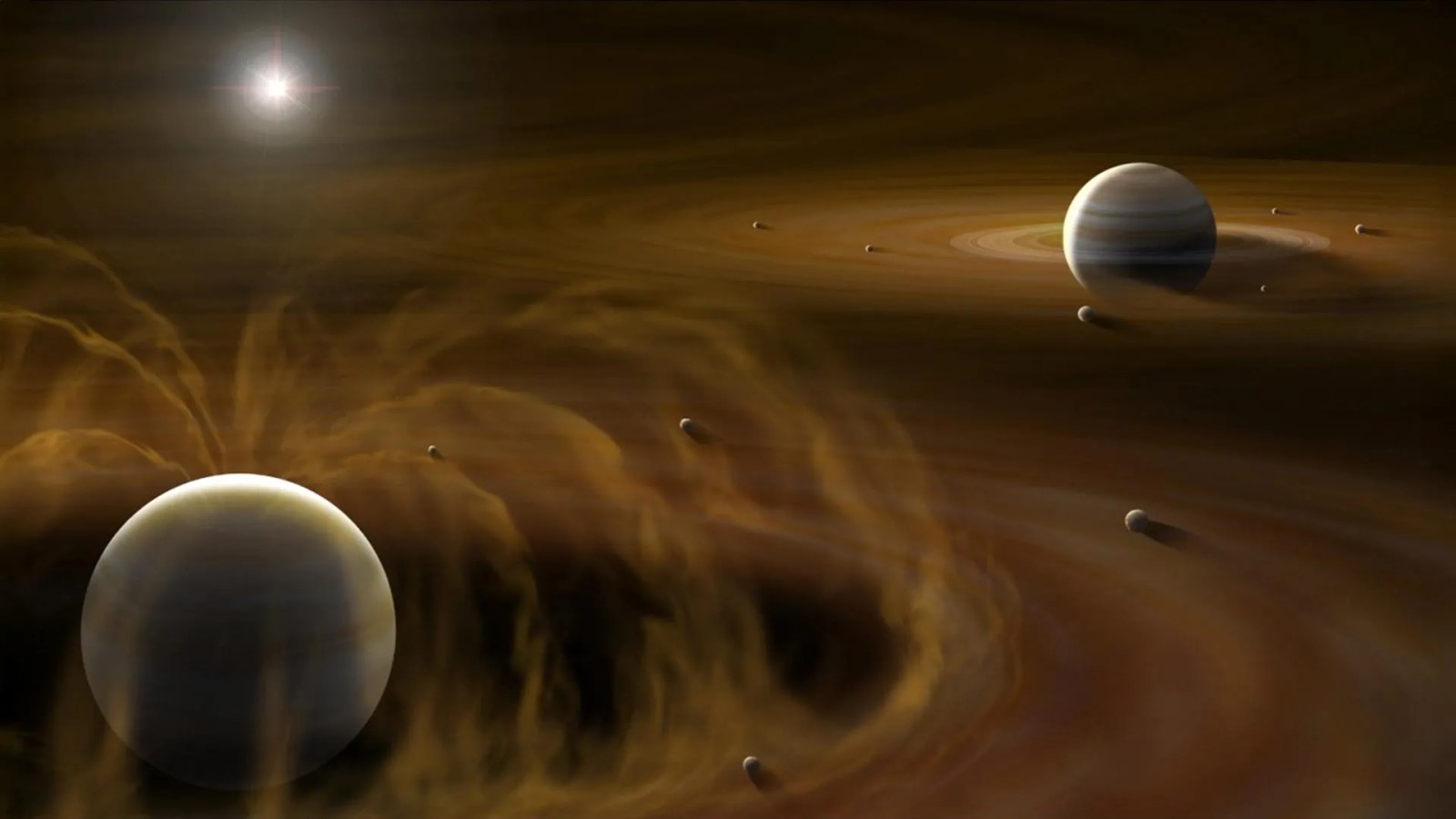
Jupiter and Saturn both have large moon systems, but their biggest moons are arranged very differently. Jupiter has four especially large moons, including Ganymede, while Saturn is dominated by Titan, according to ScienceDaily.
Researchers from institutions in Japan and China, including Kyoto University, built a new model to better explain that contrast. Using numerical simulations, they studied how the young planets may have evolved internally and how their magnetic fields may have changed over time.
The team also modeled the circumplanetary disks around both planets and ran N-body simulations to follow moon formation and orbital movement. Their results suggest the difference between the two moon systems came from differences in those disks, which were influenced by the strength of each planet’s magnetic field.
In the model, young Jupiter had a strong magnetic field that created a cavity in its disk. That protected region may have helped Io, Europa and Ganymede form and remain in place, while Saturn’s weaker magnetic field would not have produced a similar gap. The researchers say the findings could help guide future studies of exomoons and young gas giants beyond our Solar System.