
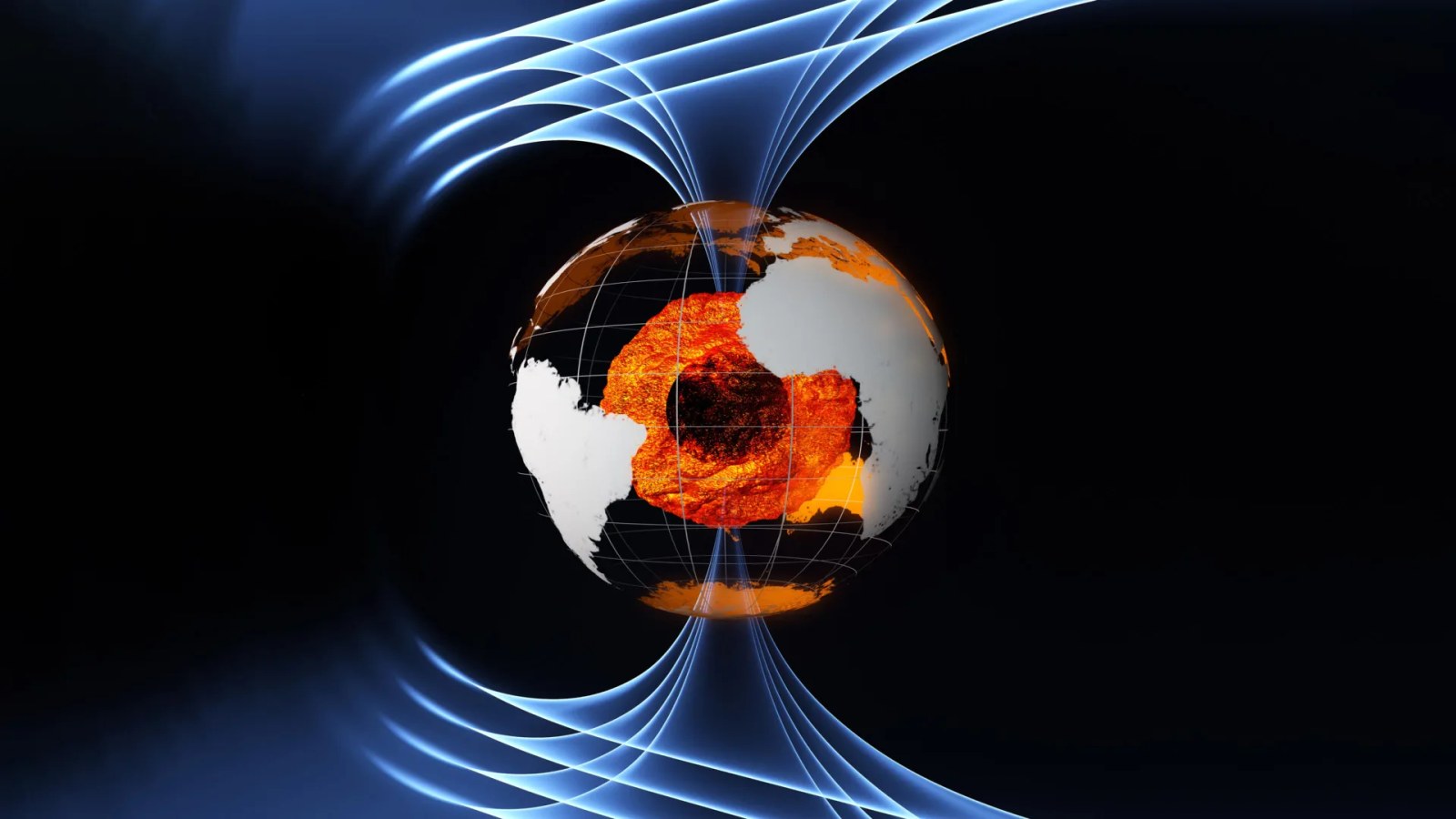
Scientists have identified a large shift in the movement of molten material deep beneath the Pacific Ocean, according to ScienceDaily. The change took place in 2010, when a broad region of iron-rich fluid in Earth’s outer core moved eastward after previously flowing weakly westward.
The outer core sits about 2,200 kilometers below the surface and is made of electrically conducting liquid iron. As that material moves around the solid inner core, it helps generate Earth’s magnetic field through a process known as the geodynamo.
The new study, published in the Journal of Studies of Earth's Deep Interior, combined ground-based observations with satellite data gathered from 1997 through 2025. Researchers used measurements from ESA’s Swarm and CryoSat missions, as well as data from Germany’s CHAMP mission and the Ørsted mission, to reconstruct changes in flow near the core-mantle boundary.
Lead author Frederik Dahl Madsen of the University of Edinburgh said the reversal raises new questions about how Earth’s deep interior behaves. Scientists do not yet know what caused the change, and the study suggests the strong eastward flow has weakened since 2020. The researchers say continued monitoring will be needed to determine whether the event was temporary or part of a longer cycle.
ESA scientists said the long-running satellite record was key to spotting the shift and tracking how core dynamics change over time. The findings also suggest that regional changes in the outer core can happen more quickly than scientists once thought, offering new clues about the magnetic field that shields Earth from charged particles from the Sun.