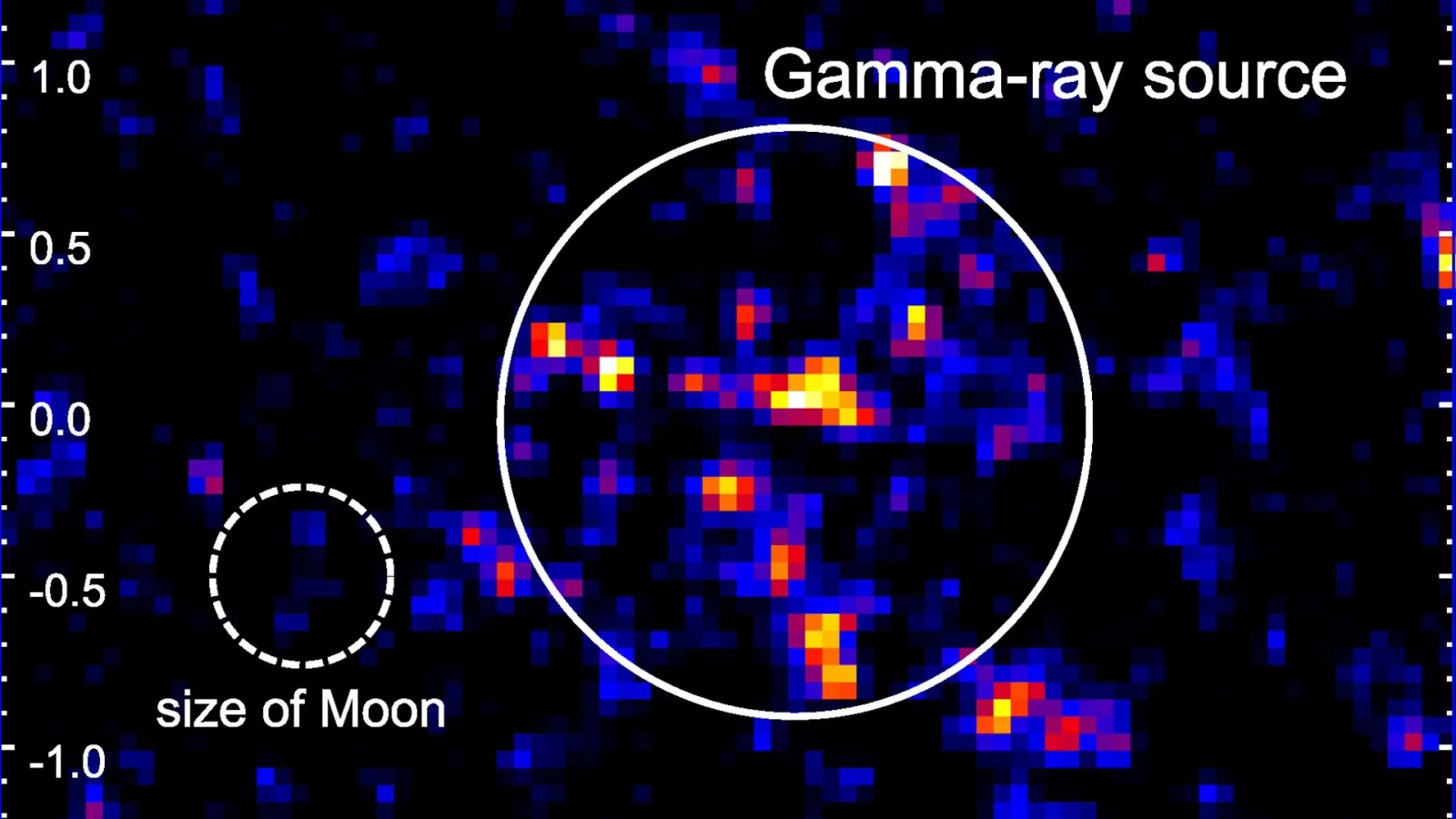
Scientists have identified a source in the Milky Way that can accelerate protons to some of the highest energies seen in our galaxy, according to ScienceDaily. The discovery may help researchers better understand cosmic rays, the fast-moving particles that travel through space between stars.
The object, known as LHAASO J1912+1014u, was confirmed by an international team led by Hiroshima University using data from several observatories on Earth and in space. The results were published in The Astrophysical Journal on July 16, 2026.
The source had already been detected in 2024 and is located in the constellation Aquila near Altair. Scientists initially thought it might be a supernova remnant, but later observations made that explanation less certain after emissions above 100 TeV were found.
By combining gamma-ray, X-ray and radio observations from instruments including Fermi-LAT, FUGIN, Chandra, Tibet AS gamma and LHAASO, the researchers concluded the object is a proton PeVatron, meaning a natural accelerator that can push protons beyond the one peta-electron-volt threshold. The team said the evidence pointed away from an electron-dominated source and toward high-energy protons interacting with surrounding gas.
According to the study, the multiwavelength data helped rule out other possibilities and revealed a detailed picture of the source. Researchers say that kind of identification could improve understanding of how cosmic rays are produced and accelerated in our galaxy.