
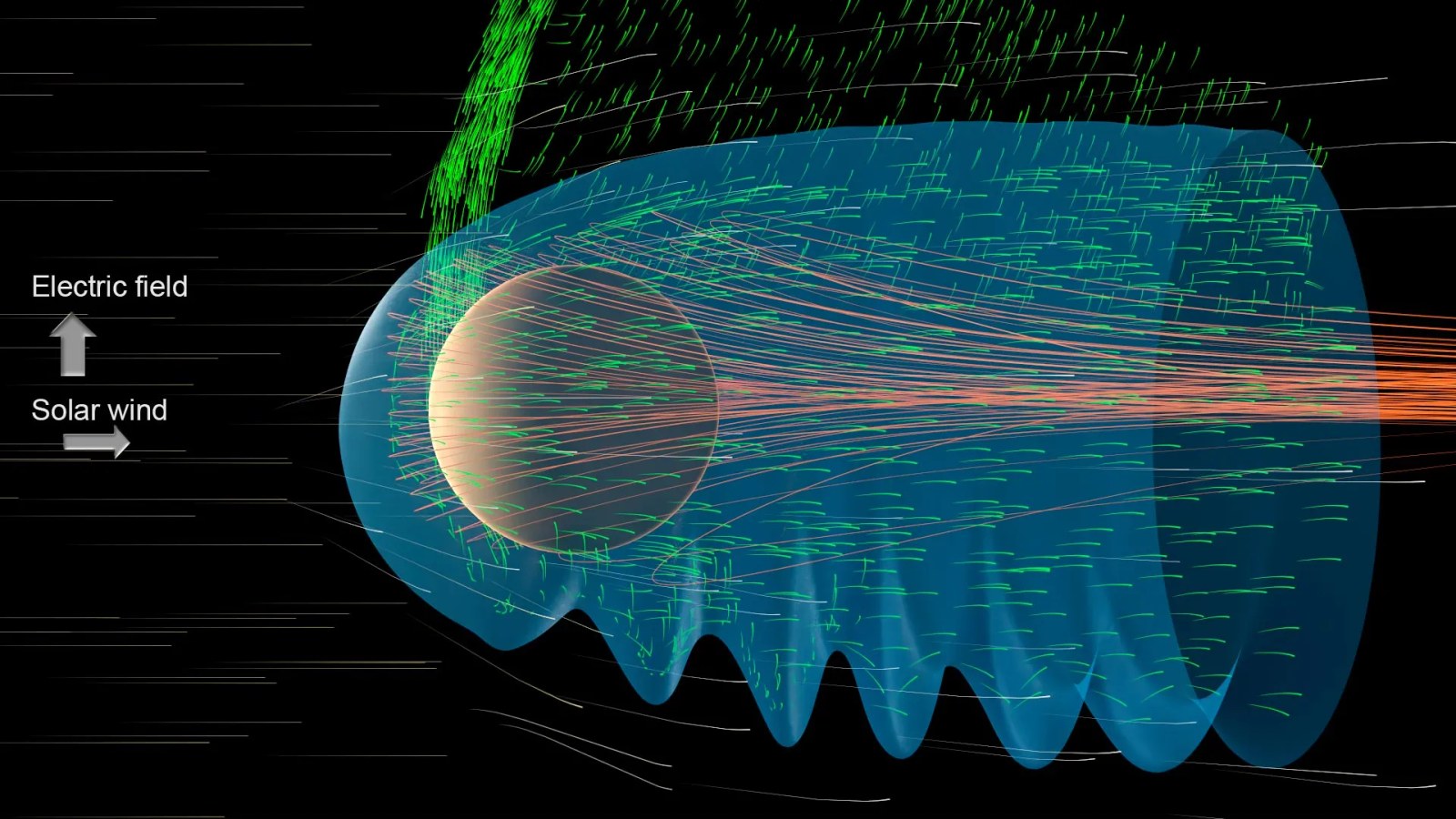
A new study led by Boston University suggests that giant wave-like disturbances in Mars’ upper atmosphere may be helping strip the planet of air, according to ScienceDaily.
The research focuses on the solar wind, a stream of charged particles that constantly flows from the Sun. Unlike Earth, Mars does not have a global magnetic field to shield its atmosphere, leaving its upper layers exposed to that flow.
Using data from NASA’s MAVEN mission and China’s Tianwen-1 spacecraft, the team compared conditions in the incoming solar wind with the movement of atmospheric ions escaping from Mars. The researchers say the measurements provide direct evidence that Kelvin-Helmholtz waves play an important role in that atmospheric loss.
According to the study, the process is not happening evenly around the planet. Instead, it appears mainly on one side of Mars, depending on the direction of the solar wind electric field. The researchers say more spacecraft observations and computer simulations are needed to understand how often the waves form and how much they contribute to Mars’ long-term atmospheric escape.
The findings may also help scientists study similar processes on other planets without strong magnetic fields, including some exoplanets.