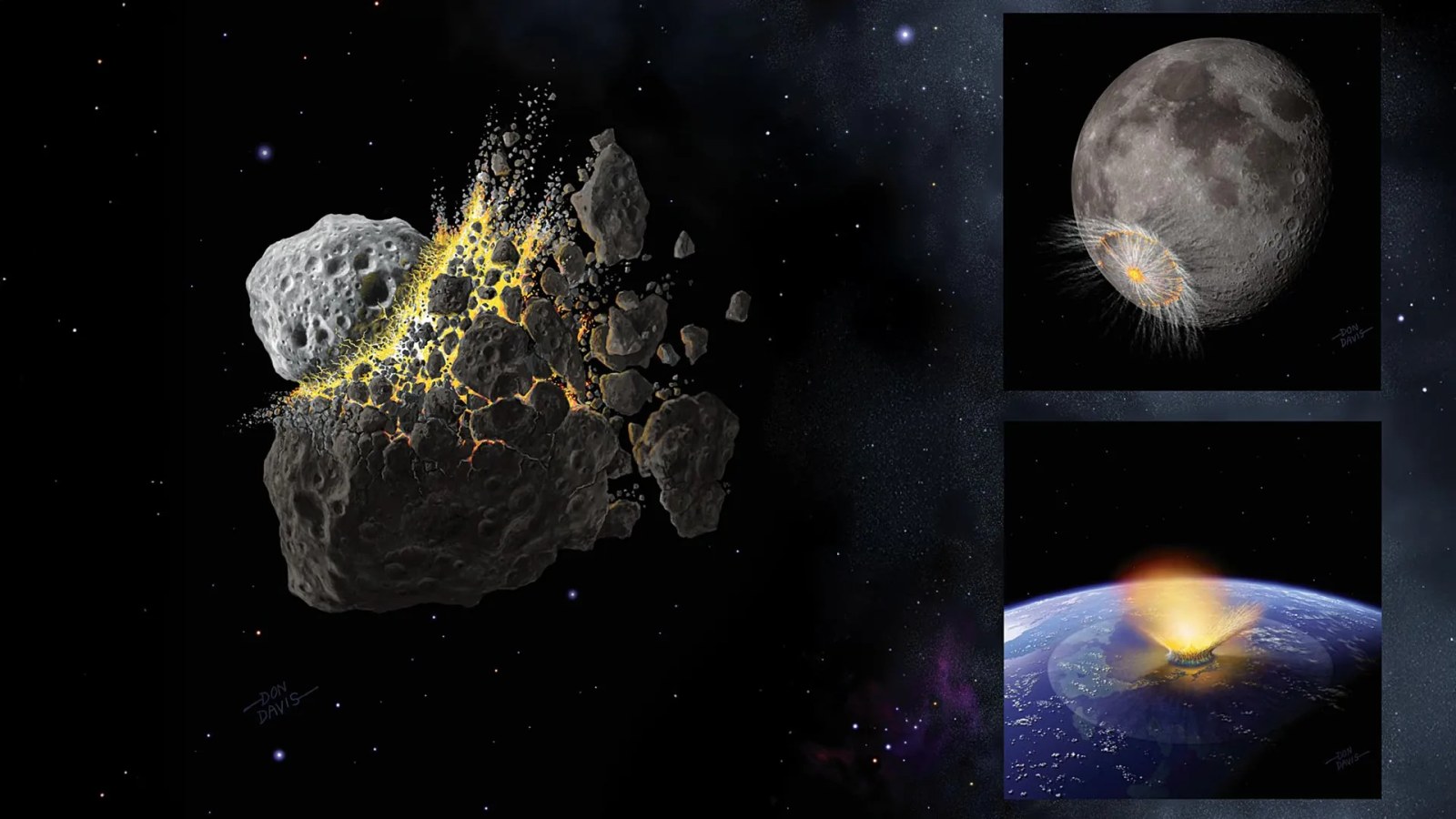
Researchers led by the Southwest Research Institute say a major collision in the main asteroid belt may have unleashed a long-lasting stream of debris that struck the inner solar system about 800 million years ago. The team believes the breakup of the object that formed the Eulalia asteroid family may have sent material toward Earth, the Moon and Mars.
According to the study, published by SwRI and described by lead author Dr. William Bottke, the Moon’s crater record and impact glass samples from Apollo missions suggest a spike in large impacts around that time. Because Earth’s surface is constantly being reshaped, very old impact evidence is much harder to find on our planet.
The researchers used collisional and dynamical models to connect the lunar evidence to the Eulalia family’s parent body, which they say broke apart near the Jupiter 3:1 mean motion resonance. In that region, repeated gravitational nudges from Jupiter can send asteroids into orbit paths that cross the inner planets.
The simulations suggest that about half of the fragments may have entered that resonance right away, with another 25% drifting in over the next 100 million to 150 million years through the Yarkovsky effect. The team says the resulting bombardment could help explain the lunar crater increase seen around 800 million years ago and may have produced broader effects across the inner solar system.
Researchers also estimate that Earth would have been hit by far more large objects than the Moon, but they caution that the study does not prove the asteroid barrage caused climate or biological changes on our planet. The timing does overlap with a period of cooling and major biological change, according to the study.