
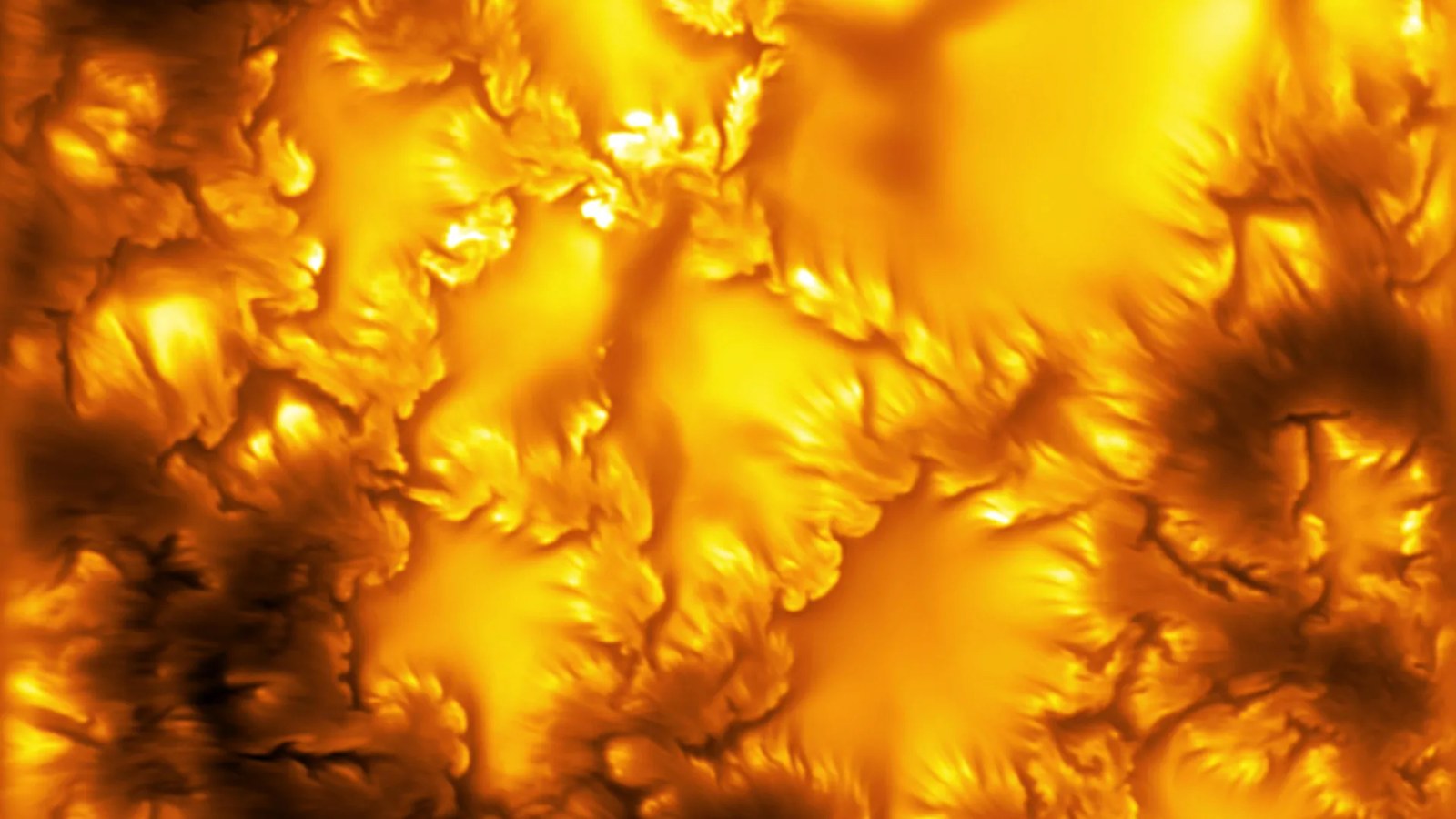
Scientists have observed previously unseen plasma vortices swirling across the Sun’s surface, a discovery that may help explain how our star stores, moves and releases magnetic energy, according to ScienceDaily.
The work was led by researchers from the U.S. National Science Foundation National Solar Observatory, the Max Planck Institute for Solar System Research in Germany and the High Altitude Observatory in the United States. They combined images from the NSF Daniel K. Inouye Solar Telescope in Hawaii with advanced computer simulations.
To identify the vortices, the team needed to resolve features about 20 kilometers across, which is near the limit of what current telescope technology and simulations can achieve. The swirling motions were found along the edges of granules, the constantly shifting structures that make up the Sun’s visible surface.
The researchers believe the patterns may be linked to Kelvin-Helmholtz instabilities, a fluid-dynamics effect that can form when nearby layers move at different speeds. They say the tiny whirlpools could also help twist magnetic field lines and mix plasma in ways that may contribute to nanoflares and the Sun’s eleven-year activity cycle.