
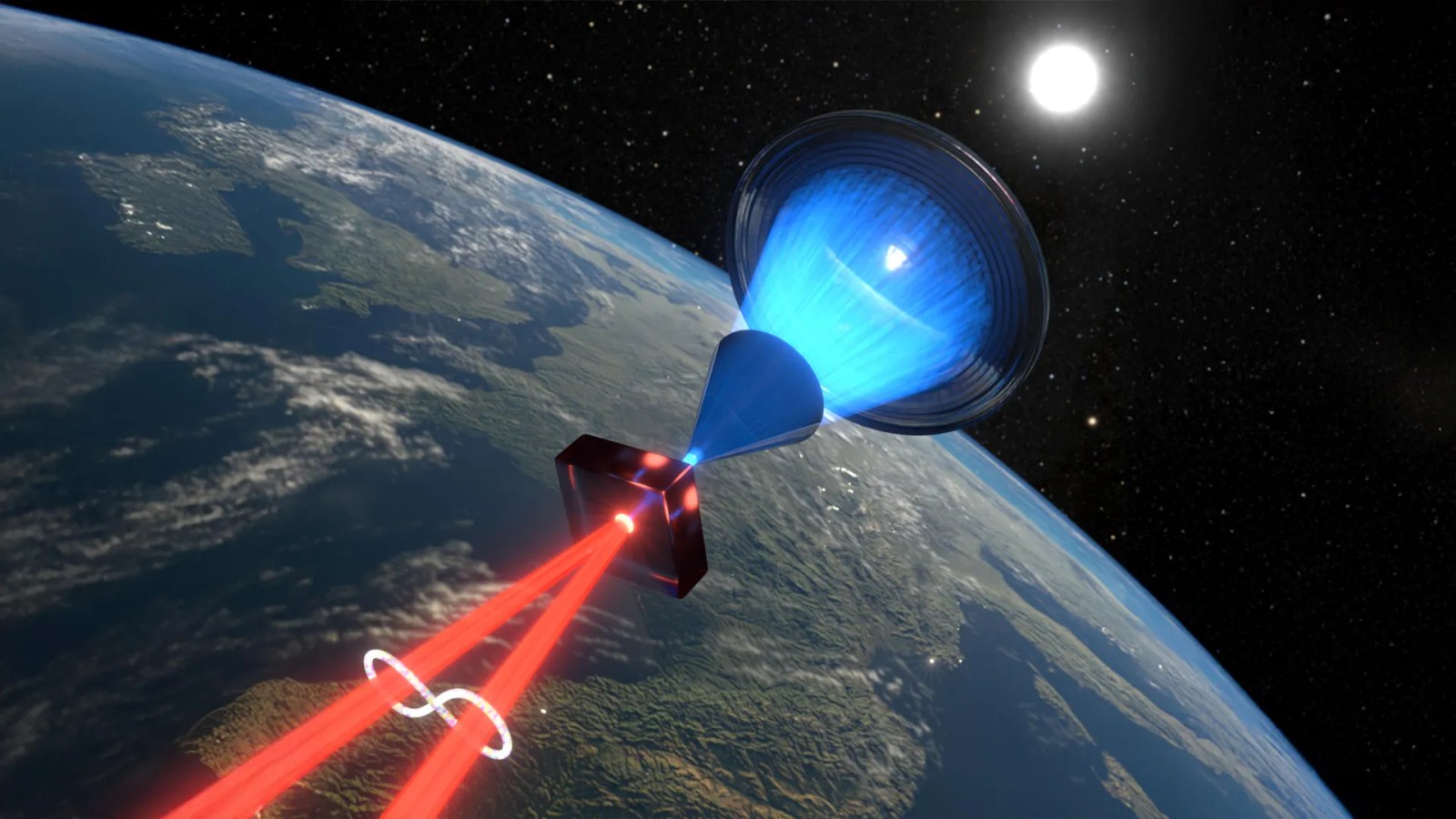
Researchers have shown that sunlight can be used to create quantum entanglement between photons, according to ScienceDaily. The work offers a possible path toward quantum technologies that use less energy than systems that rely on powerful lasers.
The study, published in Optica, found that sunlight can produce entanglement comparable to laser-based methods when differences in the incoming light’s bandwidth are accounted for. The project combined theory from Robert Boyd’s group at the University of Ottawa with a solar concentrator developed by Hanieh Fattahi’s team at the Max Planck Institute for the Science of Light in Germany.
To produce the entangled photons, the researchers used spontaneous parametric down-conversion, a process in which a pump beam enters a nonlinear crystal and can split into pairs of photons. In this case, the team used strongly polarized sunlight instead of a conventional laser, and designed the setup so color and direction differences would not affect the photons’ polarization.
Because the crystal was only about a millimeter in size, the team also needed a way to gather enough sunlight. Fattahi’s group built an all-glass solar concentrator that used a Fresnel lens to collect sunlight and send it into an optical fiber, allowing the light to reach the crystal during an outdoor test at MPL.
According to the researchers, the sunlight-produced entanglement was about 94% similar to a perfectly entangled state, and the photons violated Bell’s inequality, supporting the conclusion that genuine quantum entanglement was created. The team is now working on improving brightness and entanglement quality for possible use outside the lab.