
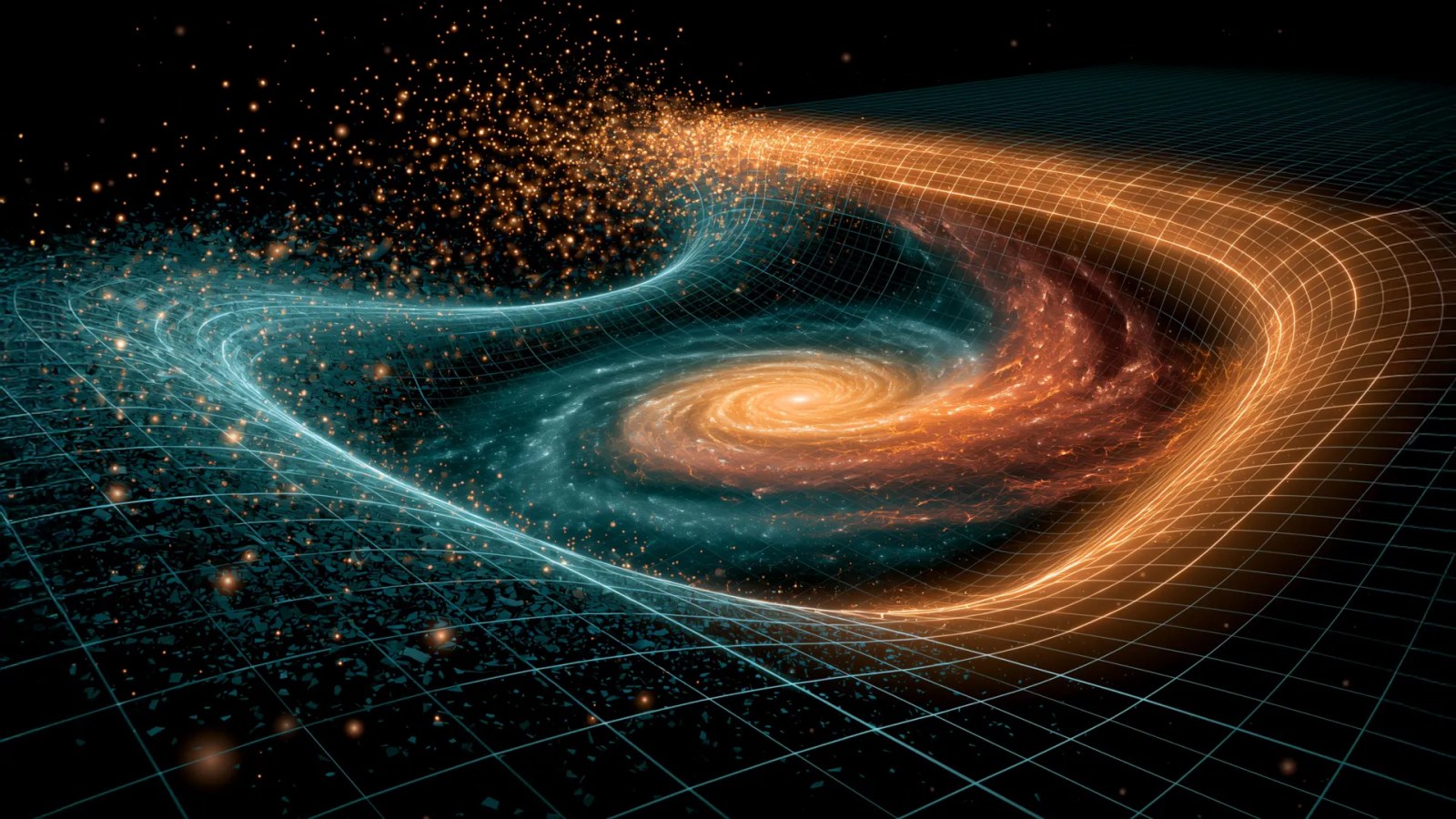
A new theoretical study is taking on one of physics’ long-running puzzles: how the Universe can keep obeying the second law of thermodynamics while still producing galaxies, stars, planets and life. The research was led by Professor Ginestra Bianconi of Queen Mary University of London, according to ScienceDaily.
The paper examines a proposal called Gravity from Entropy, or GfE, which treats gravity as something that emerges from the microscopic properties of spacetime rather than as a force on its own. In the study, Bianconi uses the framework to explore how cosmic complexity can develop even as total entropy rises.
According to the report, the analysis suggests a key distinction between total entropy and entropy per unit volume. While the Universe’s overall entropy increases as space expands, the amount of entropy in each unit of volume may decline, which could help explain how local structure forms without breaking thermodynamic rules.
The study also connects the work to earlier discoveries by Jacob Bekenstein and Stephen Hawking showing that black holes have entropy and emit thermal radiation. In the GfE model, the equations match general relativity at low energies, but begin to differ in more extreme conditions, where a changing dark energy contribution appears.
Bianconi said the research may open new ways to study the links between thermodynamics, gravity, quantum mechanics, cosmology and the emergence of complex structures. The proposal is still at an early theoretical stage, according to the material provided.