
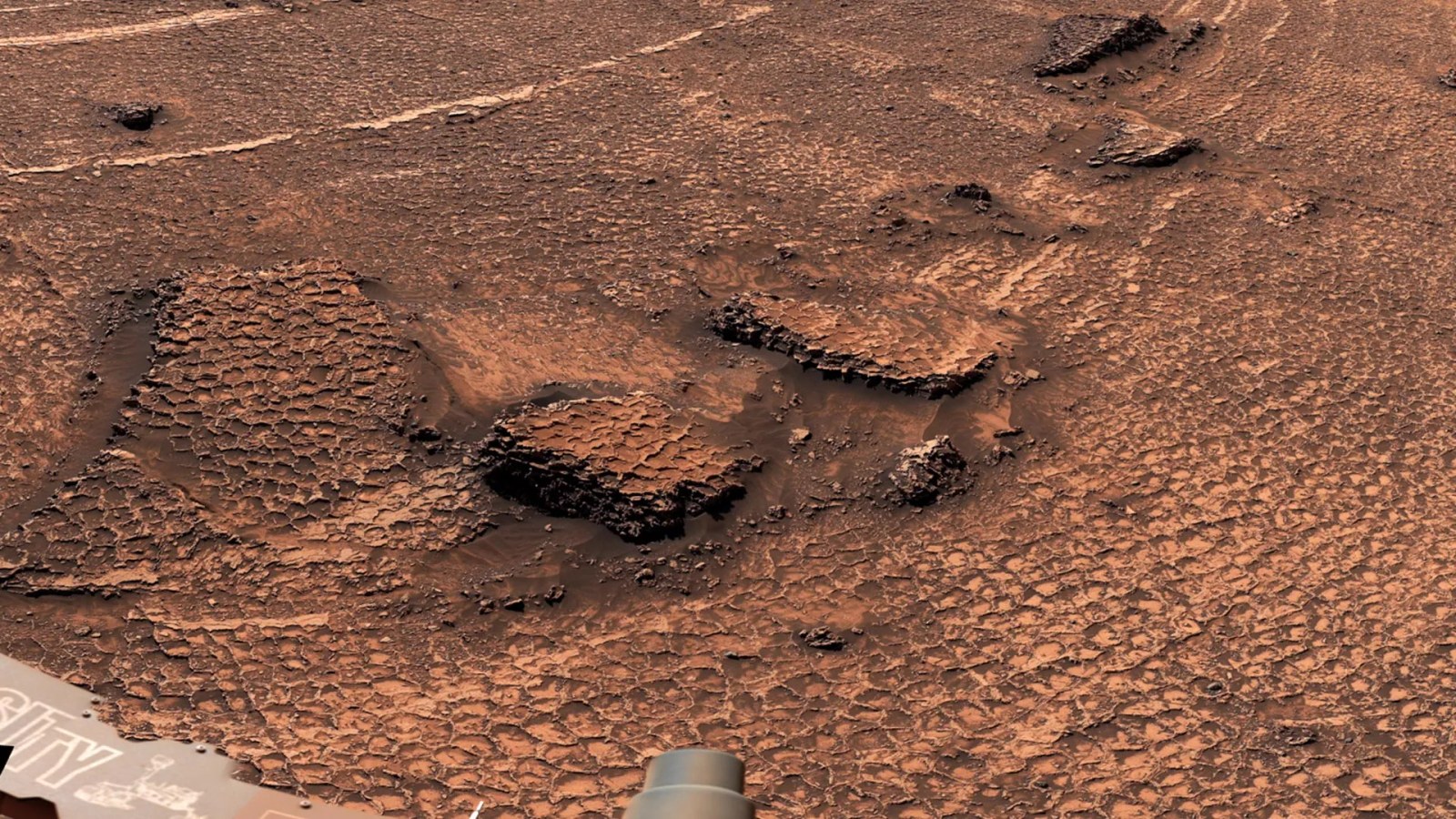
NASA’s Curiosity rover has discovered an unusual honeycomb-like landscape while traveling through a Martian valley nicknamed Valle Grande, according to ScienceDaily. The rover’s images show polygonal fractures spread across the ground in every direction.
The patterns measure about 1.5 to 3 inches, or 4 to 8 centimeters, across. Curiosity has seen smaller groups of similar shapes before, but the field in Valle Grande is far larger than anything it has observed so far.
Scientists say the polygons were captured in a 360-degree panorama taken on June 19 and 20, during the rover’s 4,930th and 4,931st Martian days, or sols. The formations also extend up the side of a nearby butte called Miraflores, which rises about 20 feet above the surrounding terrain and is topped with a layer of sand.
Mission scientist Ashwin Vasavada of NASA’s Jet Propulsion Laboratory said the scene was especially striking and that the team measured the shapes and chemistry carefully. Researchers are now trying to determine whether the patterns were formed by drying mud cracks, repeated heating and cooling, compression, or a combination of processes.
The find adds to Curiosity’s long list of discoveries since landing on Mars 14 years ago on Aug. 5, 2012. Over time, the rover has helped show that ancient Mars once had water, useful chemistry, and nutrients that may have supported microbial life.