Astronomers may have found some of the strongest evidence yet for a strange prediction from quantum mechanics: even space that appears empty can still affect the way light moves, according to ScienceDaily.
The effect, known as vacuum birefringence, was predicted nearly 90 years ago by physicist Werner Heisenberg. The idea is that a vacuum is not truly empty, but filled with virtual particles that briefly appear and vanish.
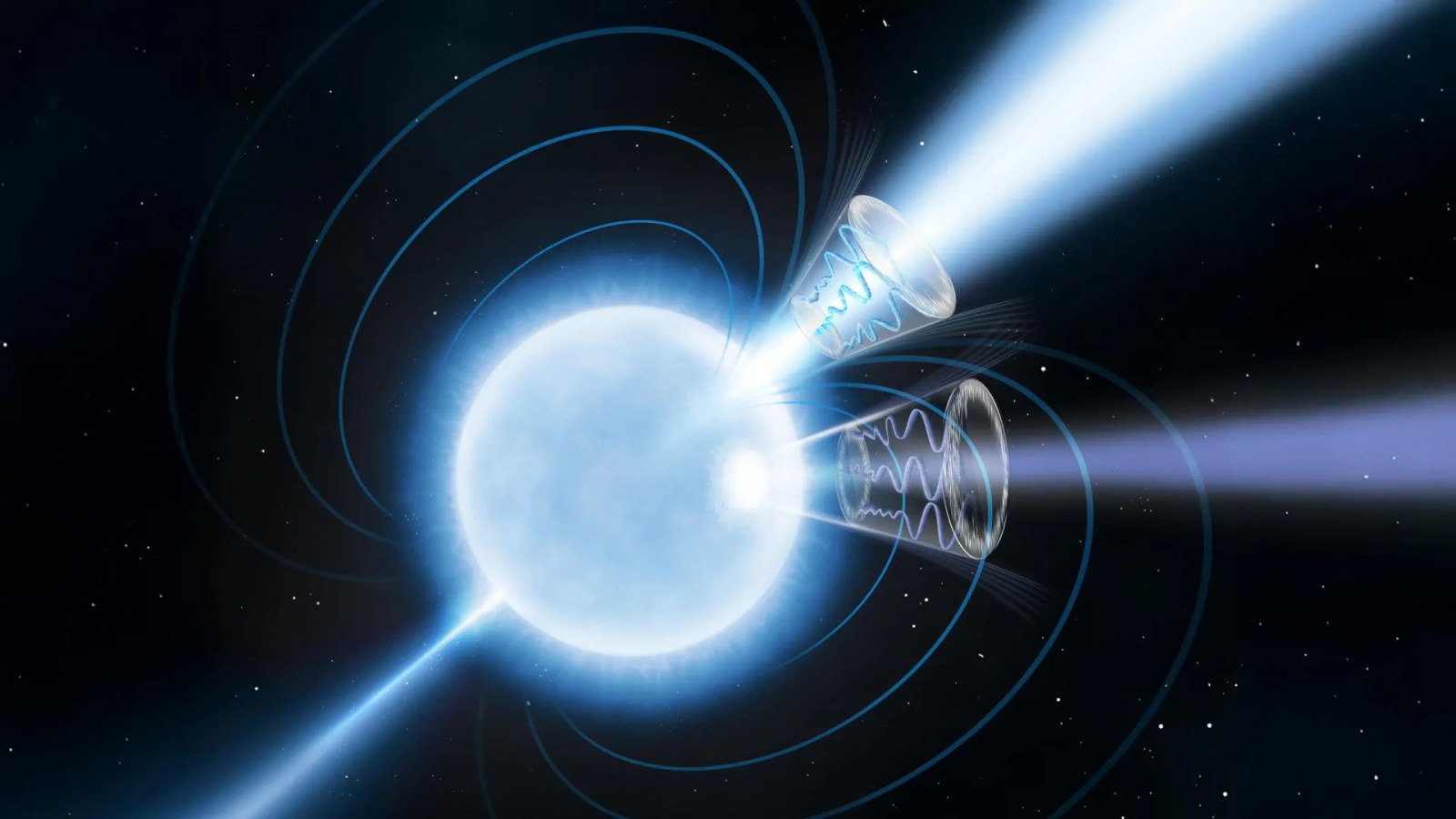
Researchers led in part by Dr. Marcus Lower of Swinburne University of Technology studied the magnetar 1E 1547.0-5408, a neutron star with one of the strongest magnetic fields known in the universe. Using NASA's Imaging X-ray Polarimetry Explorer, along with data from NICER and Murriyang, the team examined how the star's radio waves and X-rays changed as it rotated.
According to the researchers, the observations may be the first direct detection of vacuum birefringence in a magnetar's extreme magnetic field. They reported that the X-rays were highly polarized and that the polarization matched the star's magnetic field in a way consistent with the quantum prediction.
Dr. Lower said more observations and advanced simulations will be needed to confirm the result and separate the effect from other processes around magnetars. The paper was published in Nature.