
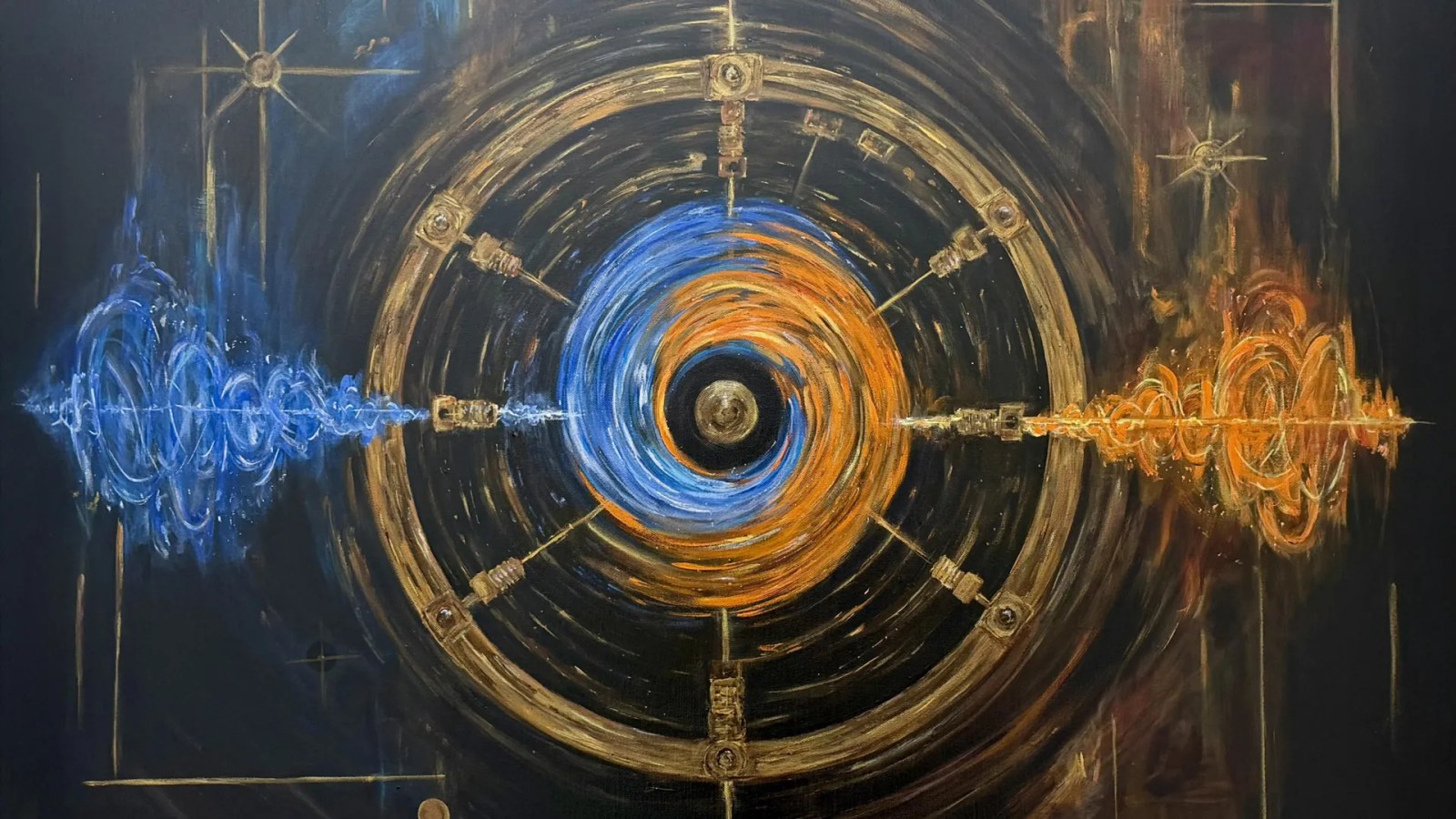
Researchers at the Advanced Science Research Center at the CUNY Graduate Center say they have demonstrated a lab method inspired by a long-standing idea about extracting energy from a rotating black hole, according to ScienceDaily.
The concept dates back more than 50 years to physicist Sir Roger Penrose, who proposed that under the right conditions a particle entering a black hole’s ergosphere could split, with one part falling in and the other escaping with more energy than the original particle. Later, physicist Yakov Zel’dovich suggested that waves could also gain energy when interacting with a sufficiently fast-rotating object.
In the new study, published in Nature, the team created a radio-frequency device whose properties were changed rapidly across space and time. That design produced the effect of ultrafast rotation without the hardware actually spinning.
By using a ring of electronic resonators with carefully synchronized changes, the researchers said electromagnetic waves could interact with the system as if it were rotating at extraordinary speed. The team reported that waves with the right rotational properties extracted energy from the setup and became amplified, reproducing the core physics behind the Penrose-Zel’dovich idea.
The researchers say the work could help open new avenues in fundamental physics and may have future applications in communications, optics, photonics and quantum technologies. They also said more research is needed before the concept could be turned into practical devices.