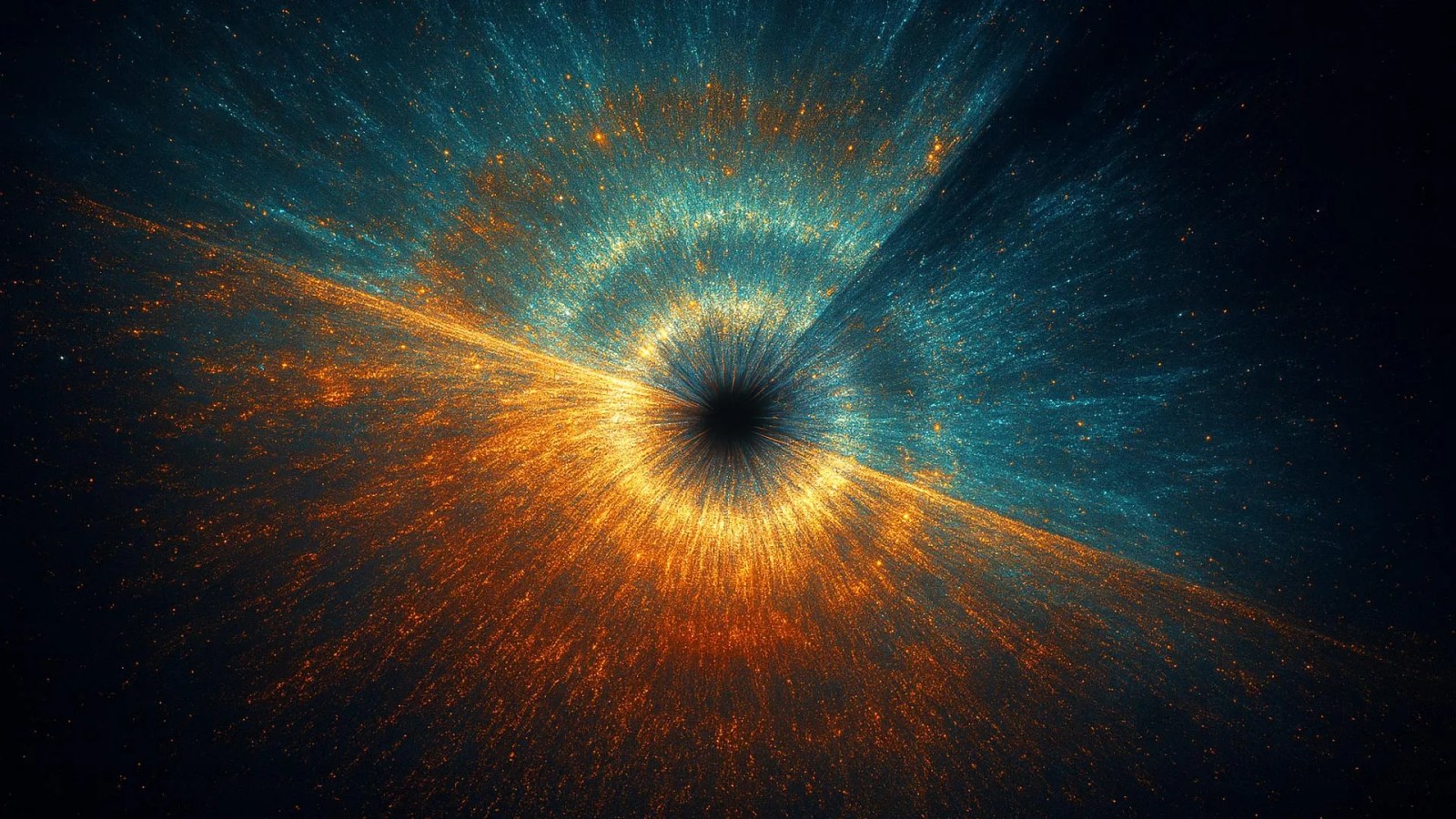
Dark matter remains one of astronomy’s biggest unknowns, but a new study suggests it may help explain several long-standing cosmic puzzles at once, according to ScienceDaily.
Researchers at the Purple Mountain Observatory of the Chinese Academy of Sciences propose that dark matter may be made up of at least two different kinds of particles rather than one. In their model, the particles differ in mass and can interact with one another in addition to gravity.
The team says those interactions can cause a process known as mass segregation, in which heavier particles move toward the centers of galaxies while lighter particles spread outward. Using simulations and theoretical modeling, the researchers found that this approach can reproduce a range of observations, including low-density dark matter cores in dwarf galaxies and compact halos that can produce strong gravitational lensing.
According to the study, the model may also help explain why astronomers are seeing more small-scale lensing events than standard dark matter theories predict. The findings were published in Science Bulletin and build on earlier work from the same research team on two-component self-interacting dark matter.