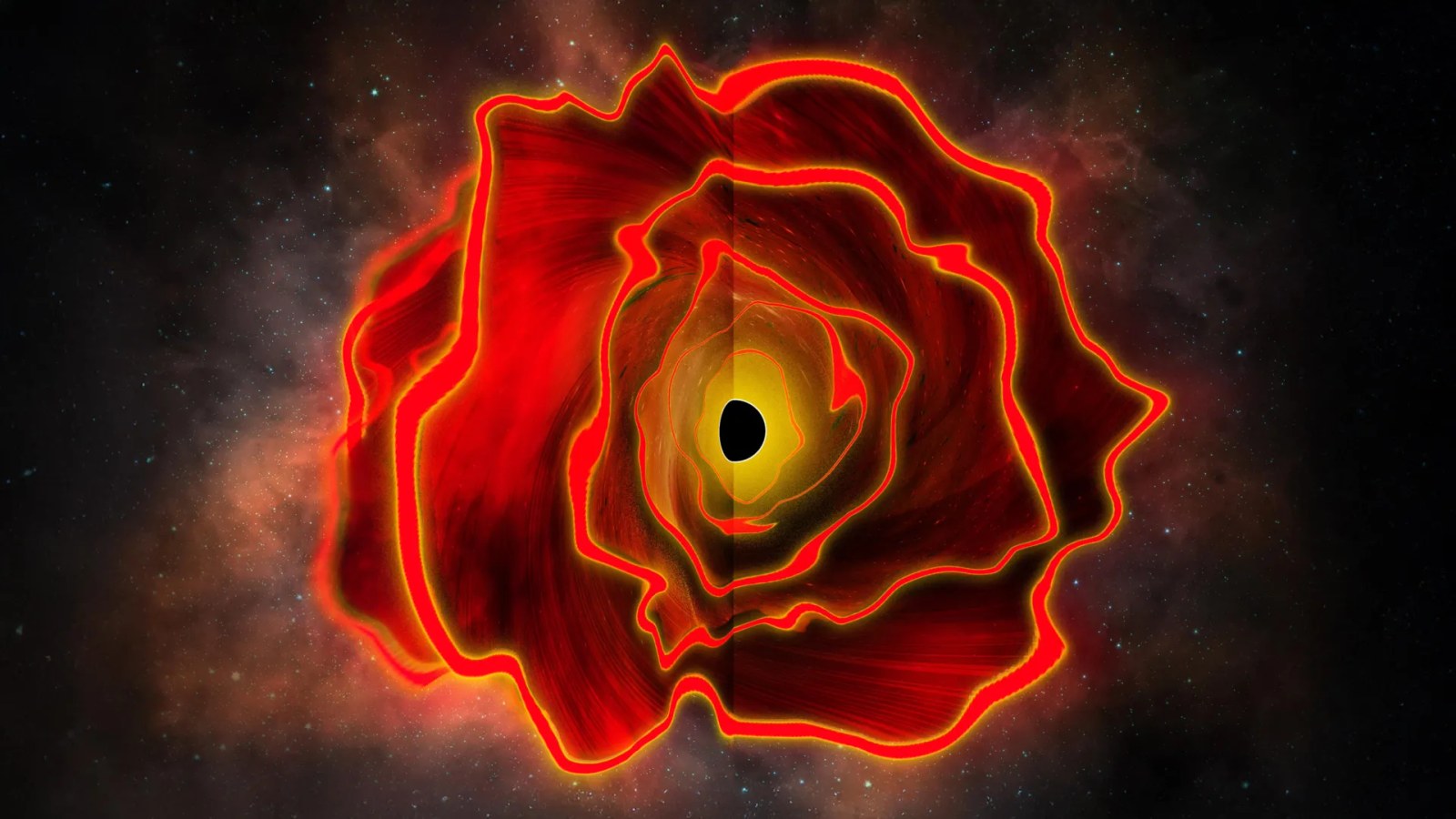
Astronomers from MIT and other institutions have identified an unusually bright red object from the early universe, according to ScienceDaily. The team says observations from NASA’s James Webb Space Telescope suggest it may be a new kind of astrophysical source they are calling a “black hole star.”
The object appears star-like in size, with a scale comparable to our solar system, but its energy output is far beyond what a normal star could produce. Researchers estimate it is shining about 100 billion times brighter than any known star could physically be.
In a study published Aug. 12 in Nature, the researchers said the object was seen only a few hundred million years after the Big Bang. Their leading explanation is that it may be a dense cloud of gas powered by a black hole at its center rather than by nuclear fusion.
Lead author Rohan Naidu of MIT said the best-fitting model points to a central black hole about 100,000 times the mass of the Sun, wrapped in an extended envelope of hydrogen. The team says the discovery could also help explain the mysterious “little red dots” that JWST has found in many deep-space images.