
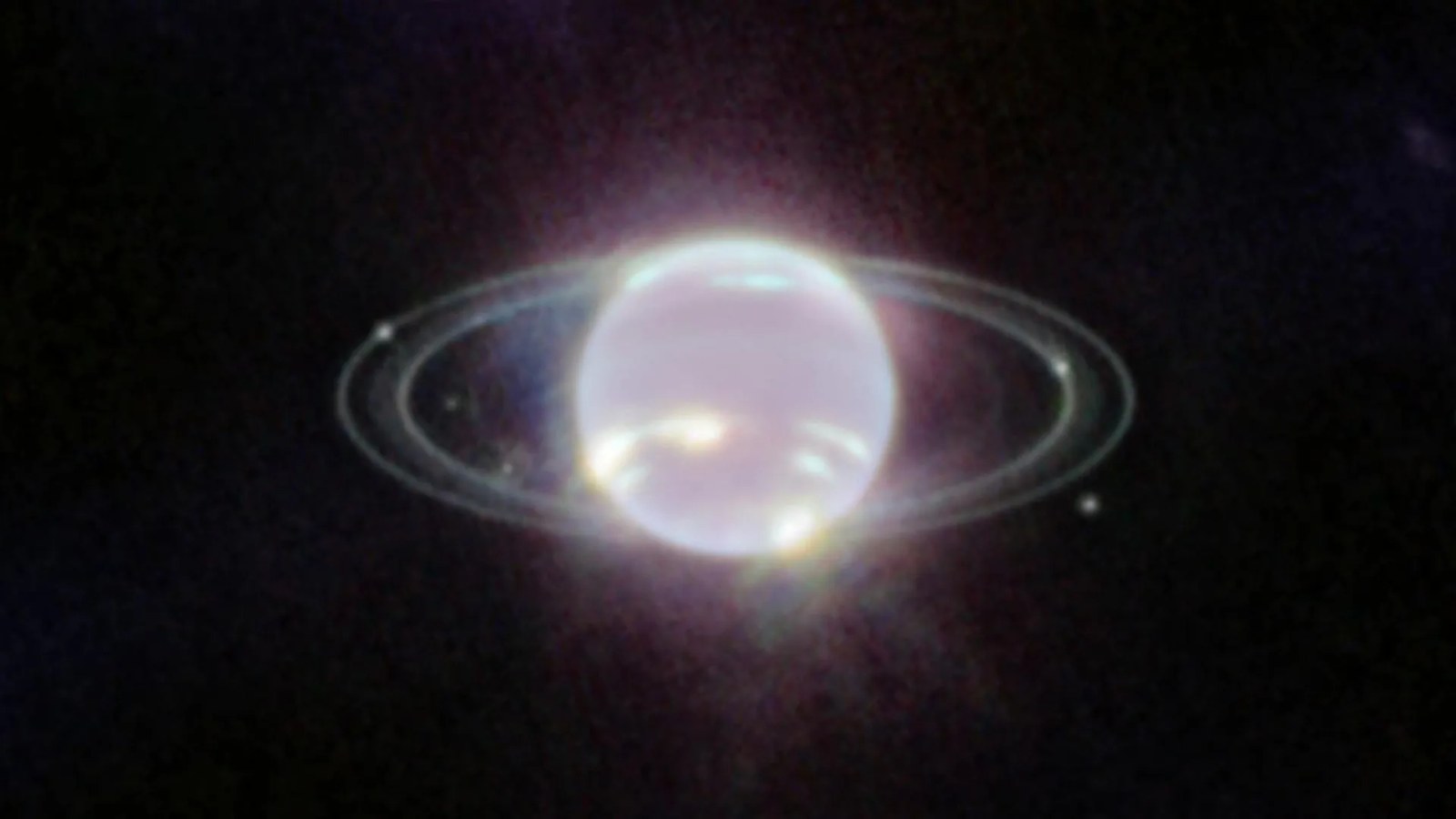
NASA’s James Webb Space Telescope has given researchers a closer look at Neptune’s rings and several of its inner moons, including Larissa, Galatea and Proteus, according to ScienceDaily. The observations found a chemical signature that scientists say is unlike anything previously identified in the outer solar system.
The findings support the idea that Neptune may once have had a very different moon system that was destroyed after Triton, Neptune’s largest moon, was captured by the planet’s gravity after forming elsewhere. Researchers think some of the debris from that event may have later come together to form the small moons that orbit Neptune today.
In the Webb data, scientists detected magnesium-rich phyllosilicates, or clay minerals, on Larissa, Galatea and Neptune’s rings. Those minerals form in the presence of liquid water, but the observations showed no sign of water ice on any of the three moons studied or in the rings.
Proteus, the largest of the small moons in the study, did not show the same clay signature. The team says that could mean it formed again from material in another part of the debris disk, or that it was heated later and lost any clay minerals it once had. Researchers also found a hydrated mineral signal across all three moons, but they have not yet identified exactly what it is.
While the scientists favor the theory that Neptune’s original moons were destroyed, they say they cannot yet rule out another possibility: that the material came from a large Kuiper Belt object that was pulled apart by Neptune’s gravity. Either way, the team says the material appears to have come from deep inside a much larger body.