
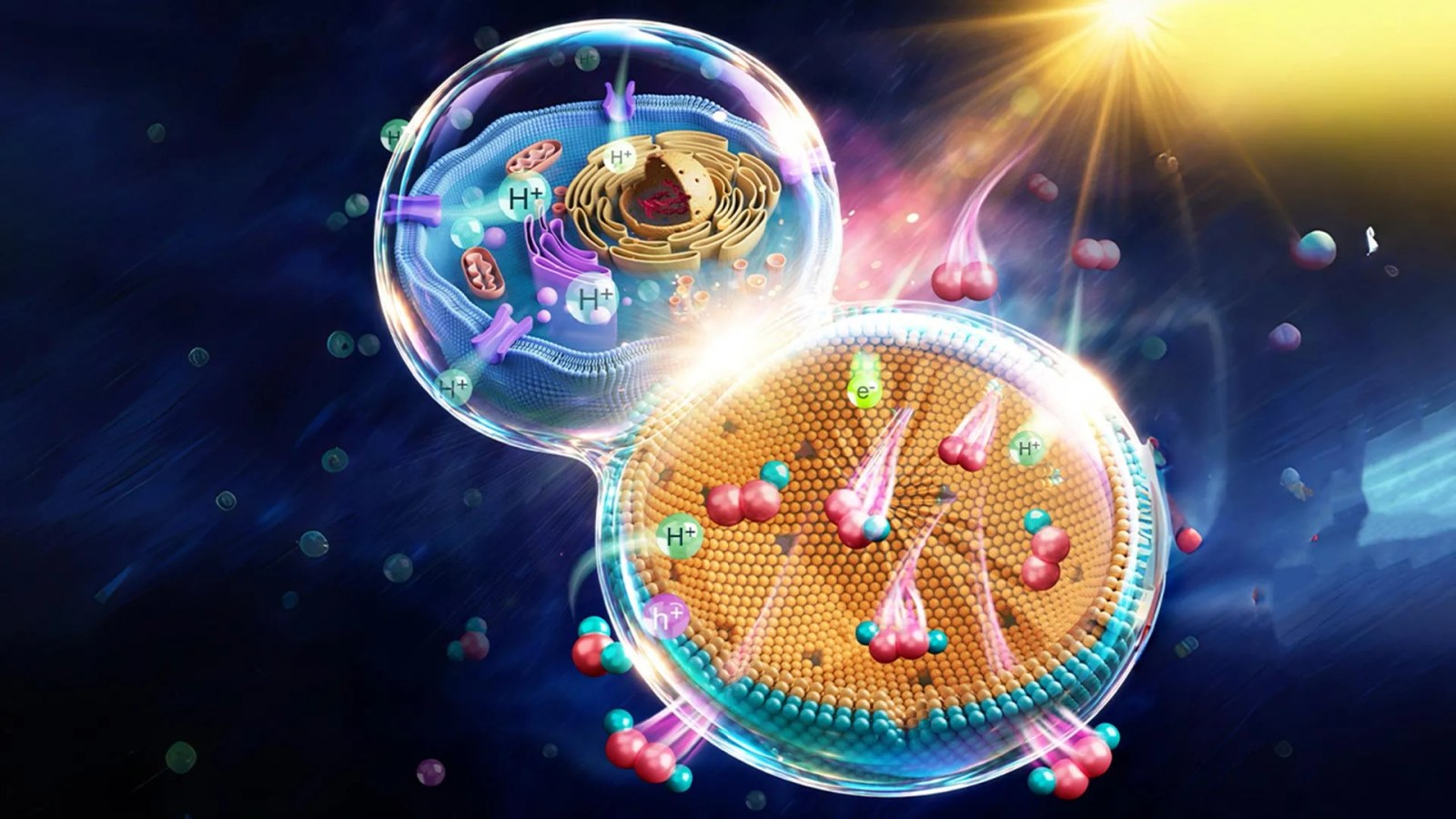
Researchers have created a hollow CdS@polydopamine nanoreactor that copies two important features of living cells, according to ScienceDaily. The work was published in the Journal of the American Chemical Society and was led by Prof. Li Can at the Dalian Institute of Chemical Physics of the Chinese Academy of Sciences, with Prof. Jian Liu's team at Inner Mongolia University.
The study is part of a field called nanocell engineering, which aims to build synthetic structures that resemble the organized environments inside cells. In this case, the nanoreactor combines a porous shell with a hollow cavity, giving reactants a confined space to gather and react.
According to the researchers, one key feature is a catechol/o-benzoquinone redox pair in the polydopamine shell that helps shuttle protons and speeds proton-coupled electron transfer. The other is the compartmentalized structure, which helps trap light and support the movement of molecules through the system.
Under visible light in water, the nanoreactor produced hydrogen peroxide at a rate of 3.24 mmol gcat.-1 h-1 and reached a solar-to-chemical conversion efficiency of 1.2%. The team also embedded the material in a sodium alginate hydrogel to create a recyclable solid catalyst that could keep making hydrogen peroxide under natural sunlight.
Prof. Li said the study offers a new strategy for biomimetic nanoreactors that better reproduce the functions of living cells, with potential uses in artificial photosynthesis, energy catalysis, and synthetic chemistry.