
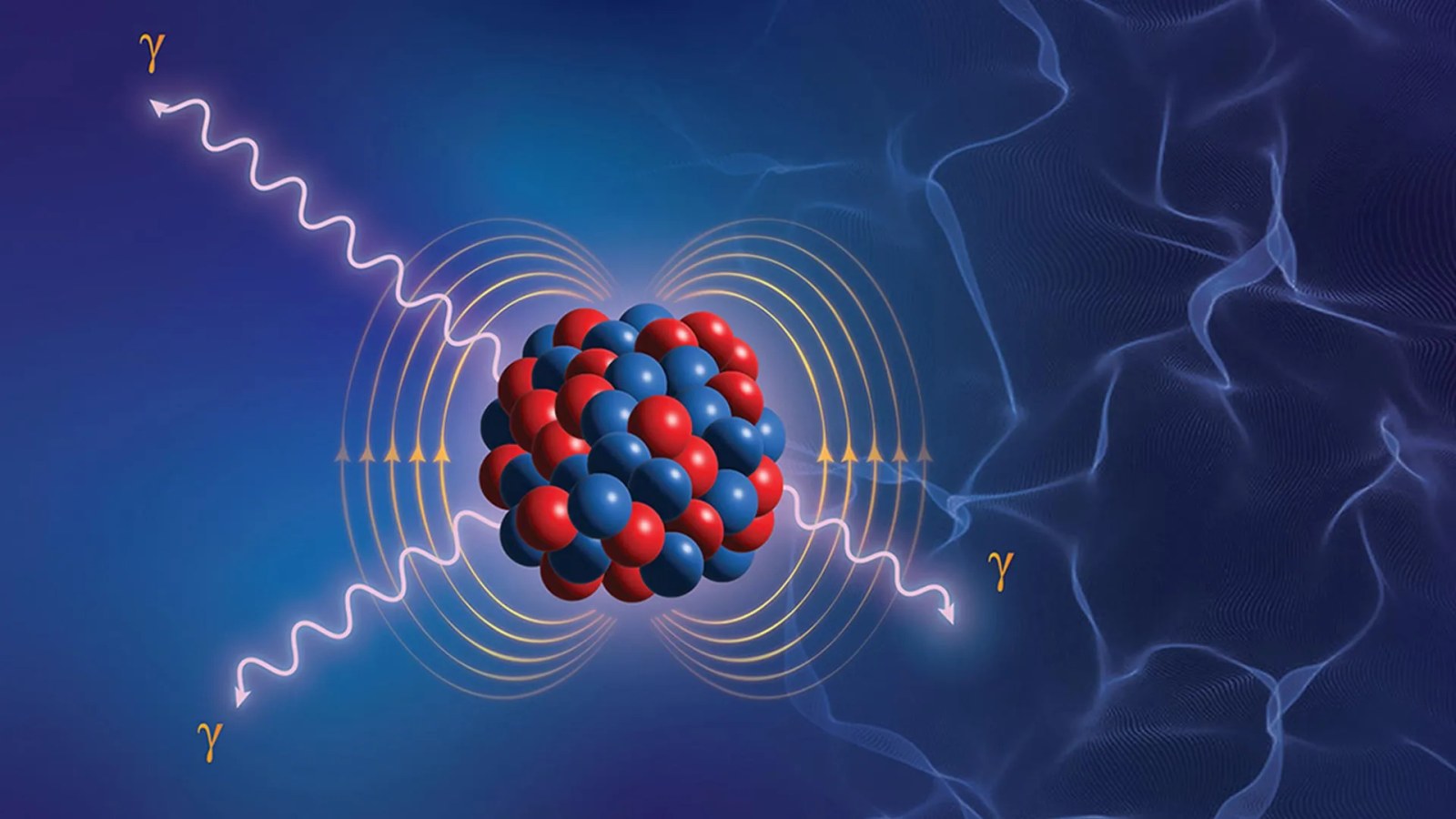
A new study led by the Facility for Rare Isotope Beams, with researchers from Lawrence Livermore National Laboratory, may have answered a long-running question in nuclear physics about why some atomic nuclei emit more low-energy gamma rays than expected, according to ScienceDaily.
The research, published in Nature, found strong evidence that magnetic transitions inside the nucleus are behind the effect known as low-energy enhancement. Scientists had observed the phenomenon for years, but it was difficult to predict which nuclei would show it.
To test the idea, the team measured gamma rays produced as a radioactive copper isotope decayed into zinc. By separating two decay states, the researchers found that the low-energy enhancement appeared only in the magnetic transition, not the electric one.
Researchers say the result could improve nuclear models and have broader uses in astrophysics, nuclear energy, national security, and nuclear forensics. The findings may also help scientists better understand reactions in stars, supernovae, and neutron star mergers that produce heavy elements.