
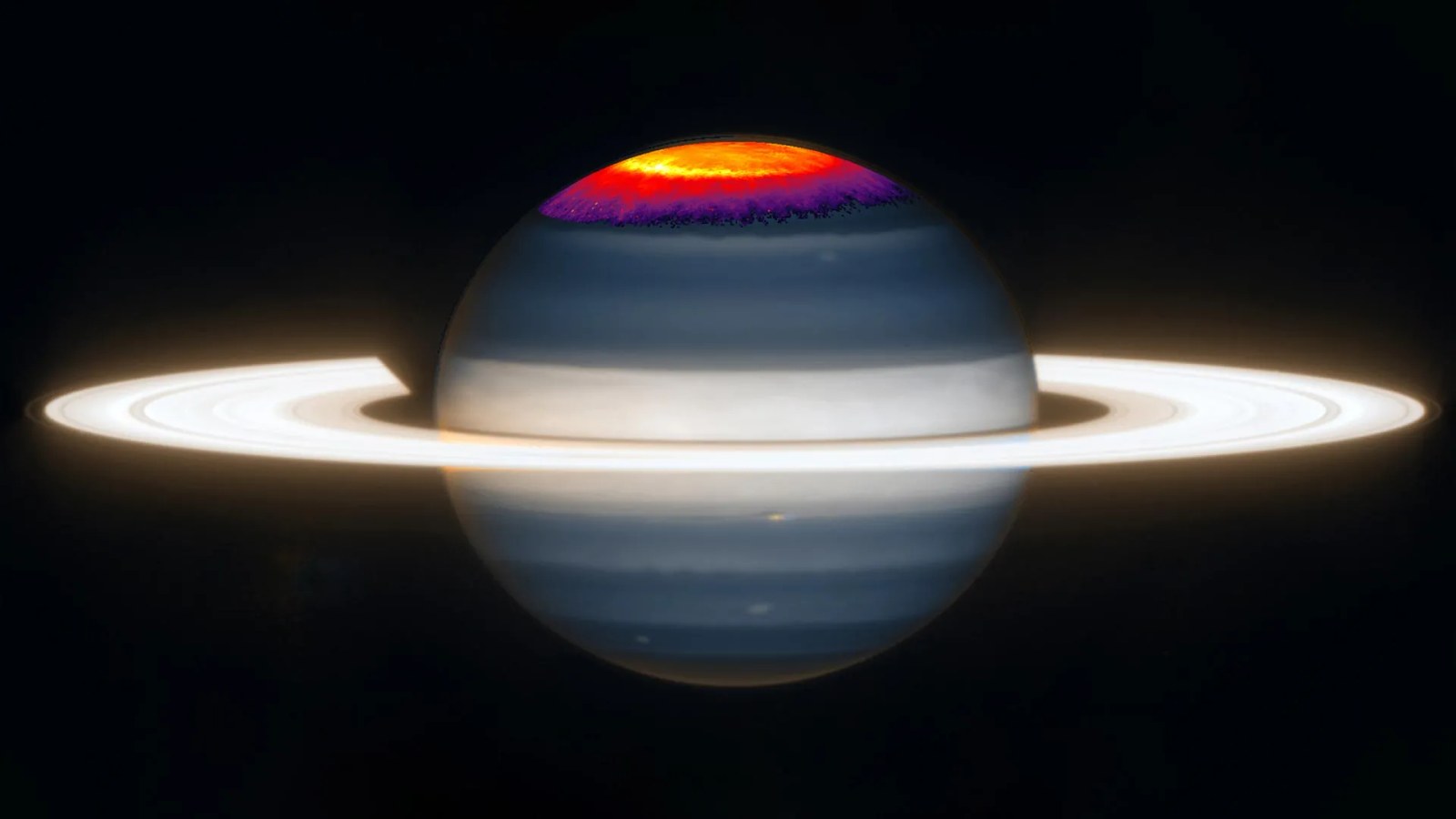
Scientists studying data from the Cassini-Huygens mission have found an unexpected detail in Saturn’s magnetic environment, according to ScienceDaily and Lancaster University researchers involved in the work.
The research, published in Nature Communications, suggests that Saturn’s fast rotation plays a major role in shaping its magnetosphere, which is the protective region around a planet created by its magnetic field. That supports the idea that giant planets can behave very differently from Earth.
Using Cassini observations collected between 2004 and 2010, the team pinpointed Saturn’s magnetospheric cusp, a funnel-like opening near the poles where charged particles from the solar wind can enter more directly. They found that, unlike Earth’s cusp, Saturn’s is shifted away from local noon and typically falls between 13:00 and 15:00 local time, with some measurements extending toward 20:00.
According to Dr. Licia Ray of Lancaster University, the result helps researchers build better theories about how planetary magnetospheres interact with the solar wind. The finding may also improve understanding of Saturn’s auroras, magnetic reconnection and the energetic particles within the planet’s space environment.
Cassini orbited Saturn from 2004 to 2017 in a mission led by NASA, ESA and the Italian space agency ASI.